On the record · DeKalb County
Housing · Nov 6, 2026 · 8 minute read
What does DeKalb's new camping law actually say?
DeKalb's new camping law passed 5 to 2. Here is what the text says, what people say it says, and how each commissioner voted, district by district.
Updated Friday, November 6, 2026, with what officials told the public, checked against the record. First published October 31.
DeKalb County Board of Commissioners, file 2026-0550; DeKalb County 2024 to 2028 Consolidated Plan (2023 count); the CEO's proposal from the county's release of November 5, 2026. Checked November 6, 2026.
Our mission is to make sure Black communities are not simply informed about the decisions shaping our future, but equipped to help make those decisions. An informed community is a powerful community.
On this page: How each commissioner voted, by district; What the law does, in plain words; What people are saying, beside the text; The gray area: panhandling, selling and living on the street; and Check what you were told
Start with what the county wrote into its own law. The ordinance says being unhoused "is a condition that cannot be criminalized," and that enforcement should target "obstructive behaviors rather than the status of being homeless." It also requires an offer of help before any arrest. Those lines are now on the record, and residents can hold the county to them.
On Tuesday, October 27, 2026, the DeKalb County Board of Commissioners passed file 2026-0550, 5 to 2. Its official title: "To Adopt an Ordinance to Amend the Code of DeKalb County to Address Public Safety, Drifting, Unauthorized Camping and Certain Public Nuisance Behaviors." It was first filed in March and put off nine times before the vote.
How each commissioner voted, by district
| District | Commissioner | Black share of residents | Vote |
|---|---|---|---|
| District 5 | Mereda Davis Johnson (seconded the motion) | about 91% | Yes |
| Super District 7 | LaDena Bolton | about 73% | Yes |
| District 3 | Nicole Massiah (sponsor) | about 72% | Yes |
| District 4 | Chakira Johnson | about 71% | Yes |
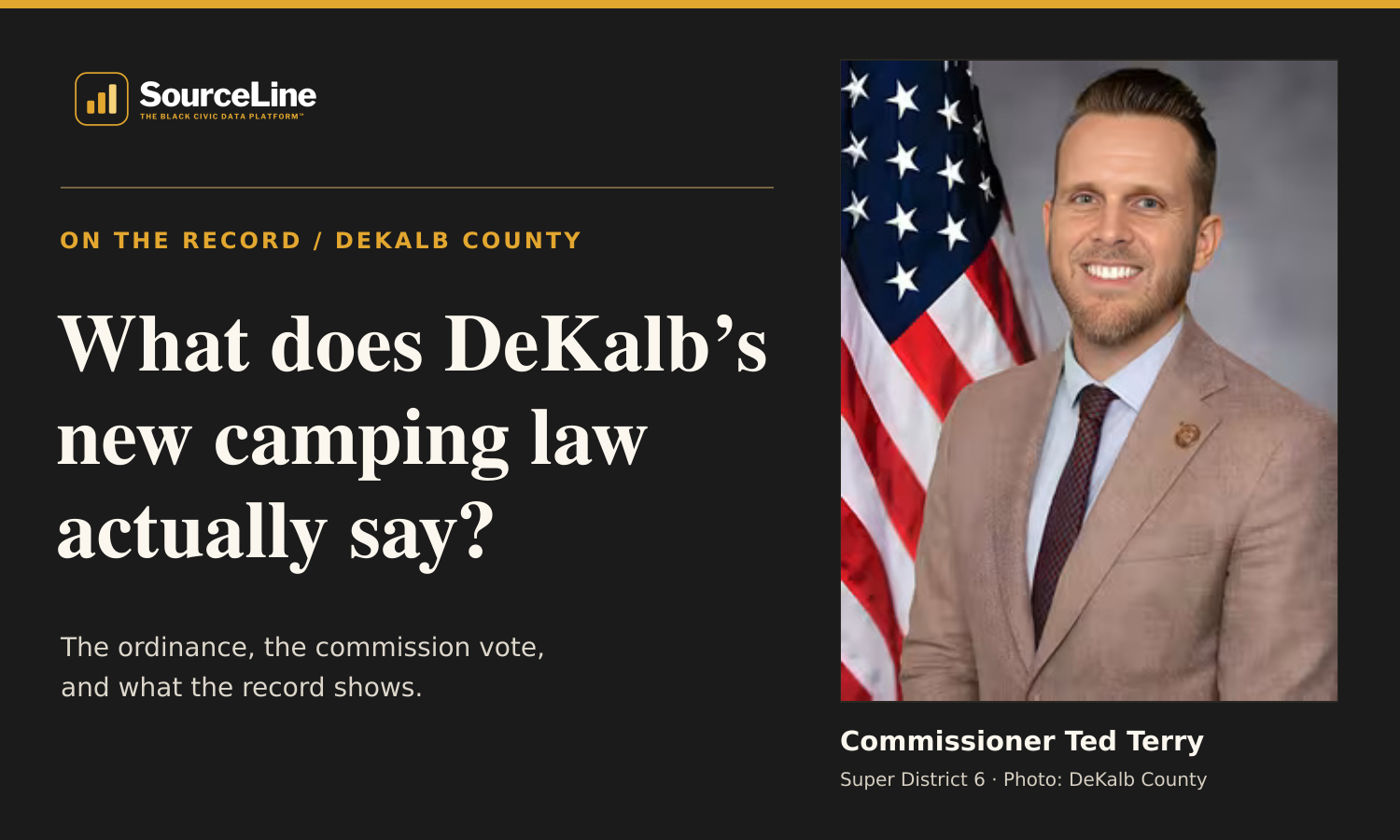
| Super District 6 | Ted Terry | about 34% | No |
| District 1 | Robert Patrick | about 23% | Yes |
| District 2 | Michelle Long Spears | about 17% | No |
Every commissioner from the four majority Black districts voted yes. Both no votes came from districts where Black residents are about a third or less. Opponents said the county's code already covers loitering, blocking traffic and begging.
What the law does, in plain words
- It makes it unlawful to "camp" in a way that blocks public property or blocks people from getting in and out. Public property means streets, highways, sidewalks, benches, parking lots, parks and medians.
- "Camp" means living in a spot, or using it as a place to live, "in a manner that obstructs public access for an extended period."
- No one can be arrested without first getting a warning and a spoken offer of services, such as a ride, shelter or a referral.
- Belongings get at least 24 hours' notice before removal, unless there is an urgent safety risk. Before a camp is cleared, the county must reach out about services and how to get belongings back.
- It is not a violation to sit or lie down in a medical emergency, use a wheelchair on a sidewalk, sit at a parade, an outdoor café, a festival or a bus stop, or use a public bench.
- It has no rule on panhandling, begging or selling. It covers only camping that blocks public property.
- It takes effect only after the CEO approves it.
What people are saying, beside the text
A post shared in a DeKalb community group said the law means "being locked up because you no longer have an address."
The text: the law says nothing about having an address. The offense is blocking public property while living there, and an arrest can only follow a warning, an offer of help and a refusal to move.
Our reading: not what the law says. The fear behind it, that people without homes will end up in jail, is one the sheriff and other opponents share. That is a forecast, covered below.
The same post said two commissioners voted against it.
The record: true. Michelle Long Spears and Ted Terry voted no.
Why the sponsor says it is needed. Commissioner Nicole Massiah, who sponsored the law, said it keeps public walkways open. She pointed to a stretch of Candler Road where a woman had to step into the street to get past, as reported by Fox 5.
News headlines called it an "urban camping ban."
The text: "Urban Camping" is the county's own name for the new section, Sec. 16-65. But it is not a ban on all camping. It covers only camping that blocks public property, after a warning and an offer of help.
Our reading: accurate words, but a headline alone does not tell you how narrow the law is. You can read the Decaturish report for yourself.
Opponents, including Sheriff Melody Maddox and Commissioner Ted Terry, say it will lead to more arrests and higher jail costs, as reported by the AJC and Fox 5.
Our reading: a forecast, not something the text says. It deserves to be watched. Terry also said on the record that no written procedures for officers exist yet.
The gray area: panhandling, selling and living on the street
On a sidewalk, a person asking for money or selling goods can look like a person living there, and the other way around. The law aims at living in a spot that blocks access, not at asking for money or selling. But it does not say how long an "extended period" is or what counts as blocking. With no written procedures yet, the difference will come down to the officer on the spot. That is where mistakes can happen, and where residents should watch how the law is used.
Check what you were told
Commissioners and the county have each made claims about this law. Here is each one beside the official record, so you can weigh it yourself.
On this page: Commissioner Ted Terry, who voted no; The county and CEO Lorraine Cochran-Johnson; Commissioner Nicole Massiah, who sponsored it; and Who it reaches
Commissioner Ted Terry, who voted no
From his paper "Beyond the Ban," posted on his website on October 30, 2026, and in Decaturish on November 2.
True: the board voted 5 to 2, and he and Commissioner Michelle Long Spears voted no. The county's official vote record matches.
Not what the record shows: "after we tabled the item to the end of the meeting," when the public had left.
The record: the county's official meeting record shows no motion to table the law on October 27. It was taken up in its place on the agenda, item 99 of 140, with about 40 items after it. The record does not show the time or who was still in the room.
Incomplete: the law gives someone "24 hours to move their tent or face arrest."
The record: the 24 hours is the notice before belongings are removed. Before any arrest, the law requires a warning and an offer of help, such as shelter, a ride or a referral.
Not what the record shows: the law "takes effect immediately."
The record: it takes effect only after the CEO approves it. As of November 6 the county record shows no signature or veto, and on November 5 the CEO proposed 120 days of preparation before it is enforced.
No published source: jail costs "between $110 and $200 every single day," against "roughly $35 to $50" for transitional housing.
The record: no source is given, and SourceLine found none published. The figures on record: an estimate by Claratel Behavioral Health and the Sheriff's Office that the county spends $29,557,638 a year to jail people held on misdemeanors who live with mental illness or addiction (as reported by The Champion), and 71% of the jail population with such a diagnosis in 2025 (as reported by the AJC).
No published source: more than $1 million for outreach and shelter "has been stalled in the PECS Committee for months."
The record: the county says its outreach legislation, item 2026-1457, was introduced in October 2026. SourceLine found no published amount for it and no record of months of delay.
His own account: "The vast majority of unhoused people in DeKalb are from DeKalb."
The record: this is what he says he saw in seven counts. The county publishes no figure on where people lived before.
Partly right: Denver cut unsheltered homelessness 64% "between 2023 and 2025," cut large encampments 91%, and "nearly 100%" of people offered a room accepted.
The record: the 64% is Denver's own count, from more than 1,400 people in 2023 to 518 in 2026, so the years run to 2026. SourceLine found no published source for the 91% or the nearly 100%.
True: a DeKalb delegation went to San Antonio and Houston "last August." 21 officials and service providers went in August 2025.
His own account: most commissioners who voted yes have never joined the yearly homeless count. There is no public list of who joins the count.
The record also shows: he writes that the county has given people "nowhere to go."
The record: on November 18, 2025, the board voted on a contract with Frontline Response for up to $570,000 for shelter, temporary housing and transition services for homeless residents. Commissioner Long Spears moved to delay it again, and Commissioner Terry seconded; that failed 2 to 5. The contract then passed 5 to 2, with Long Spears and Terry voting no. The county's record does not give their reason.
The county and CEO Lorraine Cochran-Johnson
From her letter to residents and the county's release of November 5, 2026, as also reported by WSB.
In her own words: "Residents deserve safe, accessible public spaces." And: "Equally important, individuals experiencing homelessness deserve compassion, opportunity, shelter, services, and pathways to stability. Good policy must recognize both realities."
On record: $30 million over three years for buildings that serve unhoused residents, from the $155 million housing bond the board approved on July 14, 2026.
County's own figures: a 400 bed emergency shelter, listed for December 2025; a South DeKalb day center that cost $1.7 million and had served 1,070 residents by August 31, 2026; a planned $1.5 million North DeKalb day center; and Park 500, an $8 million project with 60 units for single mothers with children. The county expects the bond to help create or preserve more than 10,000 housing units. These come from the county; SourceLine has not found an independent count of beds or visitors.
A proposal: 120 days to prepare before enforcement. Proposed, not adopted. The release does not say whether she signed the law.
Commissioner Nicole Massiah, who sponsored it
Her own account: a woman on Candler Road had to step into the street to get past a camp (as reported by Fox 5). There is no record either way; it is her account of why the law is needed.
Who it reaches
In DeKalb's 2023 count of people experiencing homelessness, 88% were Black, according to the county's own housing plan. About 54% of all DeKalb residents are Black. Any law about living on public property reaches Black residents first.
On this page: Who decides next and What you can do this week
Who decides next
- You and your neighbors: where you stand counts, and your commissioners answer to your vote.
- The CEO, Lorraine Cochran-Johnson: The county record shows no signature or veto as of November 6. On November 5 she proposed 120 days to prepare before the law is enforced. A question to ask: will you sign it, and what written procedures will officers follow?
- The commission: the five who voted yes could override a veto. A question to ask your commissioner: how will you know if this law is jailing people instead of helping them?
- The state: Georgia's 2023 law, SB 62, requires local governments to enforce bans on public camping. In April 2026 lawmakers also passed HB 295, letting property owners file claims when local governments do not enforce those bans.
- The courts: in 2024 the U.S. Supreme Court ruled in City of Grants Pass v. Johnson that cities may enforce camping bans.
What you can do this week
- Ask the CEO's office whether she has signed the law and what officers will follow during the 120 days.
- Enter your address on SourceLine to see which commissioners represent you and how they voted.
- Watch how the law is used. If you see it applied to someone who was not blocking anything, write it down: the date, the place, what happened.
- Ask your commissioner for the source of any number they give you.
Facts in this story come from DeKalb County's official record of the vote and the ordinance text, the county's housing plan, and the Census Bureau. News reports are labelled as reports. SourceLine's own reading is labelled as ours.
Key figuresBy the numbers
District 5, yes
Super District 7, yes
District 3, yes
District 4, yes
Super District 6, no
District 1, yes
District 2, no
Bars for the seven districts, from District 5 at about 91% to District 2 at about 17%. Estimated from Census tracts, 2020 to 2024.
Your statement on the record
Weigh in
What does this story mean for you, your family or your community? Tell us in your own words.
Keep reading
- 865,449public housing homes left, December 2025, down from about 1.4 million in the mid 1990s Housing · Oct 29When public housing becomes Section 8, who gets to come home?
- 69,000fewer Black men in federal jobs than in 2024 (Census Bureau survey estimate) Jobs · Nov 669,000 Black men lost federal jobs. Why didn't anyone count them?
- About 11 millionBlack voters nationwide: 9% of a record 124 million ballots (CNN Voter Poll by SSRS, a survey estimate, applied to the University of Florida Election Lab count) More stories · Nov 6Black voters moved in 2026. What did it win, and what comes next?
Get SourceLine by email
When a county commission, city council or school board decides something that touches the Black community, we will tell you what happened, who voted and how to be heard. Pick what matters to you.
How we counted, and where every number comes from
The text. We quote the latest version of the ordinance the county has posted, the substitute of August 25, 2026, which matches the June 9 version in every rule. SourceLine had not found the final adopted text when we checked. SourceLine can no longer find the March original, titled with the word vagrancy, online.
The vote. Each commissioner's vote comes from the county's official roll call for file 2026-0550 on October 27, 2026.
District shares. Black residents as a share of all residents in each commission district, estimated by placing Census tracts (American Community Survey, 2020 to 2024) inside the current district lines. They are close estimates, not official district counts.
The 2023 count. The 88% figure is as stated in the county's 2024 to 2028 Consolidated Plan for the DeKalb Continuum of Care. The plan's sheltered and unsheltered counts do not add exactly to its stated total; we use the plan's own percentage.
Sources
- DeKalb County Board of Commissioners, file 2026-0550, roll call of October 27, 2026, and ordinance substitutes of June 9 and August 25, 2026. DeKalb Legistar
- DeKalb County, 2024 to 2028 Consolidated Plan. dekalbcountyga.gov
- U.S. Census Bureau, American Community Survey, 2020 to 2024.
- Decaturish, AJC and Fox 5, October 2026.
- Georgia General Assembly, SB 62 (2023) and HB 295 (2026). legis.ga.gov
- U.S. Supreme Court, City of Grants Pass v. Johnson (2024).
- Commissioner Ted Terry, Beyond the Ban, October 30, 2026.
- DeKalb County, CEO addresses Urban Camping Ordinance, November 5, 2026; WSB, November 6, 2026.
- The Champion (Claratel and Sheriff estimate); Westword (Denver count); Citizen Portal (Texas trip).
- DeKalb County Board of Commissioners official record: file 2026-0550, October 27, 2026 meeting; Frontline Response shelter contract, November 18, 2025.
Checked November 6, 2026. Found an error? Write to info@mysourceline.com.