The 2026 midterm, national
Nov 6, 2026 · 5 minute read
Black voters moved in 2026. What did it win, and what comes next?
On November 3, more than 124 million Americans voted, a record for a midterm, and Black voters moved with one voice: about 9 in 10 backed the Democrat for the U.S. House. Five Black governors were elected in one night, more than in all of American history before it. Here is what moved, what it won, and what you can do next.
Last updated Friday, November 6, 2026, morning Eastern. Counts are unofficial until each state certifies.
Ballot counts are unofficial until each state certifies. Survey figures are estimates. Checked November 6, 2026.
Our mission is to make sure Black communities are not simply informed about the decisions shaping our future, but equipped to help make those decisions. An informed community is a powerful community.
On this page: Across the country: a record midterm, and one voice; State by state: where every Black ballot can be counted; and Five Black governors in one night
Across the country: a record midterm, and one voice
More than 124 million ballots were cast in the 2026 midterm, a record, the University of Florida Election Lab reports (ABC News).
Black voters were 9% of everyone who voted, about 11 million people if that share holds across the record count, the CNN Voter Poll by SSRS estimates (about 80,000 voters, updated November 4). They backed the Democrat for the House 90% to 9%. Black women voted 93% to 6%, and Black men 86% to 12%.
The AP Voter Poll, a survey of more than 100,000 voters in all 50 states conducted by SSRS for The Associated Press and six news networks, estimates that nationwide:
- About 9 in 10 Black voters backed the Democrat in their U.S. House race, up from about 8 in 10 who voted for Kamala Harris in 2024.
- Only about 1 in 10 Black men backed the Republican for the House, down from about one quarter who voted for Donald Trump in 2024.
Black men's votes in 2024 were the most talked about shift in the country. In 2026, Black men and Black women moved together.
Black voters also voted early. The NAACP reports that Black early and absentee voting ran ahead of 2022 at the same point in Georgia, Florida, Texas and Michigan, from 20% higher in Georgia to 53% higher in Texas (NAACP, an advocacy organization, November 4). "Once again, Black voters have proven that we are not bystanders in this country, we are its builders," said NAACP President and CEO Derrick Johnson.
On Election Night, LaTosha Brown, a cofounder of Black Voters Matter, a voting rights group, said turnout in some states looked like 2008, when Barack Obama first ran, and especially high in Michigan and Mississippi (Associated Press, via PBS NewsHour, November 3). The National Coalition on Black Civic Participation had more than 2,000 poll observers working, and its president, Melanie Campbell, said that watch continues through the count and certification.
State by state: where every Black ballot can be counted
Most states do not ask your race when you register, so no official national count of Black voters exists yet; the Census Bureau's national survey of who voted comes months after the election. A few Southern states do record race, and their own files show the early vote.
North Carolina. 600,699 Black voters cast an accepted early or mail ballot, beside 408,585 in the 2022 midterm. That is 192,114 more, up 47%. Black voters cast 21.2% of all early and mail ballots, up from 18.6%. The count grew in 96 of 100 counties; in Mecklenburg County it rose 68%, to 96,291.
Georgia. At least 838,672 Black voters voted early in person or by mail by the night before Election Day, beside 741,633 in all of the 2022 midterm. That is about 97,000 more, up 13%, and it grew in 119 of 159 counties: Henry up 24%, Gwinnett 20%, Cobb 15%, Fulton 12%. In Georgia, about 9 in 10 Black men voted for Keisha Lance Bottoms, beside about three quarters for Harris in 2024 (AP Voter Poll, a survey estimate).
Louisiana. 179,094 Black voters voted early through October 27, beside 98,008 in 2022, up about 83%, from Louisiana Secretary of State data (KPLC). Black voters were nearly 35% of the early electorate, the highest early turnout among Black Louisianans since 2008, Capital B News reports.
Five Black governors in one night
Before Tuesday, three Black people had ever been elected governor of a state. On November 3, five Black governors were elected, the Joint Center for Political and Economic Studies reports, more than doubling that history from three to seven:
- Keisha Lance Bottoms, Democrat, Georgia. The first Black woman elected governor of any state. With 99% counted, she had 54.3% of the vote (CBS News).
- Byron Donalds, Republican, Florida. The first Black Republican elected governor, and Florida's first Black governor. About one quarter of Black men in Florida voted for him, and about 1 in 10 Black women (AP Voter Poll, a survey estimate).
- Aaron Ford, Democrat, Nevada. Nevada's first Black governor.
- David Crowley, Democrat, Wisconsin. Wisconsin's first Black governor.
- Wes Moore, Democrat, Maryland. Reelected.
A first is a first in either party. Every one of these governors is measured the same way from here: by what their record does for Black families.
2022 midterm 2026
Georgia (2026 as of Nov 2)
North Carolina (2026 as of Nov 4)
Counts of ballots cast, from each state's voter file. Unofficial until certified. They show who voted, not how.
On this page: More Black voices in the U.S. Senate; Mississippi is still counting; Your vote, from your street to Congress; Who decides, from you up; What you can do this week; and One thing to do
More Black voices in the U.S. Senate
Black representation in the Senate grows from five to at least six, a record, the Joint Center reports. Juliana Stratton, Democrat, was elected in Illinois, and Cory Booker, Democrat, was reelected in New Jersey.
CBS News projects Democrats will hold at least 54 seats in the new Senate, with Alaska and Mississippi still counting, and a majority in the House. About 9 in 10 Black voters backed Democrats for the House. That is power, and power comes due: every member elected with Black votes now builds a record on judges, the budget, health care and food aid, and SourceLine will measure it by what it does for Black families.
Other races Black voters helped decide: in Texas, Democrat James Talarico defeated Republican Ken Paxton in the most expensive Senate race in state history (CBS News), after working to earn Black voters' support, the Houston Defender reported. In Michigan, Democrat Abdul El-Sayed defeated Republican Mike Rogers (CBS News).
Mississippi is still counting
In Mississippi, Democrat Scott Colom leads Republican Senator Cindy Hyde-Smith by about 1,800 votes in news counts, with affidavit and late mail ballots still being counted. No news outlet has called the race. If his lead holds, Colom would be the first Black U.S. senator from Mississippi since Blanche K. Bruce, whose term ended in 1881 (Magnolia Tribune).
Mississippi has the largest Black share of any state, 36.4% (Census Bureau, 2020 to 2024). NAACP members and volunteers are in all 82 counties helping voters make their affidavit ballots count (CNN). Follow every update on SourceLine's Mississippi count watch: https://mysourceline.com/stories/mississippi-senate-count-watch/
Your vote, from your street to Congress
The power that moved on November 3 lives in your address. Type your ZIP code or street address to see, by name, who represents you in your state legislature and in Congress, and the share of citizens of voting age where you live who are Black.
Who decides, from you up
You and your neighbors. You decided the 2026 midterm. The next elections for city, county and school board come sooner than you think. Ask: when is my next election, and who is on my ballot?
Your county election office. It counts every ballot and certifies your county's result. Ask: when will our county's official count be posted?
Your state. Georgia certifies by November 20. Mississippi's counties certify by November 13, and its Secretary of State, Michael Watson, declares the result on December 3. Ask your state's chief election officer: when will my state post who voted, by race, for Election Day?
Your members of Congress. The new Congress is sworn in on January 3, 2027. Ask your two senators and your House member: what will you do in your first 100 days for families in our community?
What you can do this week
- Voted an affidavit ballot in Mississippi without a photo ID? Take an acceptable photo ID to your county circuit clerk's office by Tuesday, November 10, or your vote does not count. Mailed ballots postmarked by November 3 count if they arrive by November 10.
- Help one person. If you know someone who voted by affidavit in Mississippi, ask if they have shown their ID yet.
- Know who represents you. Type your address below. Save your senators' and your House member's phone numbers.
- Watch what is decided next. Your address page shows what is being decided for your city, county and state now, who decides and the next date to weigh in.
One thing to do
Type your address and write down the names of the three people who represent you in Congress. They were elected with your vote. Now they answer to it.
Key figuresBy the numbers
Where you live
Enter your ZIP code or street address, in any state, to see the people who represent you in your state legislature and in Congress, by name, and the share of citizens of voting age where you live who are Black.
Your statement on the record
Weigh in
What does this story mean for you, your family or your community? Tell us in your own words.
Keep reading
- 2,010Scott Colom's lead in the Associated Press count, 12:36 pm Eastern, November 6 More stories · Nov 6Mississippi Senate count: who leads, and which ballots are still out?
- 838,672Black Georgians who voted early or by mail in 2026, at least More stories · Nov 3How many Black voters voted early in Georgia and North Carolina in 2026?
- 92%of registered Black men ages 18 to 45 say voting is important (Black Men Vote survey, 2026) More stories · Oct 31Black men believe in voting. Who is speaking to them?
Get SourceLine by email
When a county commission, city council or school board decides something that touches the Black community, we will tell you what happened, who voted and how to be heard. Pick what matters to you.
How we counted, and where every number comes from
No official national count of voters by race exists yet; the Census Bureau's Current Population Survey voting supplement comes months after the election. National figures here are the Election Lab's ballot count and the CNN Voter Poll and AP Voter Poll survey estimates, both conducted by SSRS. About 11 million Black voters is an estimate SourceLine built by applying the CNN Voter Poll's 9% Black share to the Election Lab's count of more than 124 million ballots; it is not a count. Georgia and North Carolina early and mail ballot counts come from each state's voter file in the SourceLine database. Louisiana's are the Secretary of State's figures through October 27 as reported by KPLC, with the 2008 comparison from Capital B News. South Carolina, Alabama and Florida also record race on their voter rolls; SourceLine hasn't updated those states' 2026 files yet. Coming soon. Georgia counts ballots cast early in person, by mail or by electronic delivery as of the evening of November 2, 2026, beside the final 2022 count; some 2026 ballots are not yet linked to a race, so the Black count is the lowest it could be. North Carolina counts accepted early and mail ballots as of November 4, 2026, beside the final 2022 count. Election Day voters by race come when the states post their full voter history after certification, and SourceLine will add them then. These counts show who voted, never how anyone voted. AP Voter Poll figures are survey estimates (SSRS for The Associated Press, ABC News, CBS News, CNN, FOX News Media, NBC News and Versant; October 22 to November 3; margin of error about 0.6 points for the full sample, larger for groups). NAACP early vote figures are the NAACP's own, an advocacy organization, and it does not name its data source. Race calls are the news outlets', credited by name; SourceLine does not call races.
Sources
- CNN Voter Polls, Election 2026, national results, U.S. House, conducted by SSRS (79,668 respondents), updated 11:30 am Eastern, Nov 4, 2026
- SourceLine database, private.turnout_race_sex_county: Georgia Secretary of State voter file (2026 as of Nov 2, 2026; 2022 final) and North Carolina State Board of Elections absentee file (2026 as of Nov 4, 2026; 2022 final)
- ABC News, "Record voter turnout marks 2026 midterm election" (University of Florida Election Lab figure)
- KPLC (Devin Cruice), "Early voting up 38% statewide; Black early votes in Calcasieu more than double 2022," Oct 28, 2026 (Louisiana Secretary of State data through Oct 27)
- Capital B News (Adam Mahoney), "Louisiana Lost a Majority-Black District, but Black Voters Are Still Showing Up," Nov 3, 2026
- Associated Press (Linley Sanders, Humera Lodhi and Amelia Thomson-Deveaux), "Young voters led a sharp shift toward Democrats in the 2026 midterms, The AP Voter Poll finds," Nov 4, 2026, via KSAT
- Joint Center for Political and Economic Studies, "Black Representation in the 2026 Midterm Elections," updated 2:15 pm Eastern, Nov 4, 2026
- NAACP, "NAACP Applauds Strong Black Voter Turnout in 2026 Midterm Elections," Nov 4, 2026
- Associated Press, "Black voter turnout appears high on Election Day, according to voter coalition," via PBS NewsHour, Nov 3, 2026
- CBS News, "Where Democrats won big in the 2026 midterms," updated 8:58 am Eastern, Nov 5, 2026
- Houston Defender, "Earning the enthusiasm: James Talarico pushes for Black voters"
- CNN, "The fight is growing over ballot counting in Mississippi's tight Senate race," Nov 6, 2026
- ABC News, Mississippi results table, 1:45 am Eastern, Nov 6, 2026
- Magnolia Tribune, Nov 5, 2026
- Mississippi Free Press, live blog, 2026 U.S. Senate results
- Mississippi Secretary of State, Voter ID
- U.S. Census Bureau, American Community Survey 2020 to 2024, five year estimates (SourceLine database)
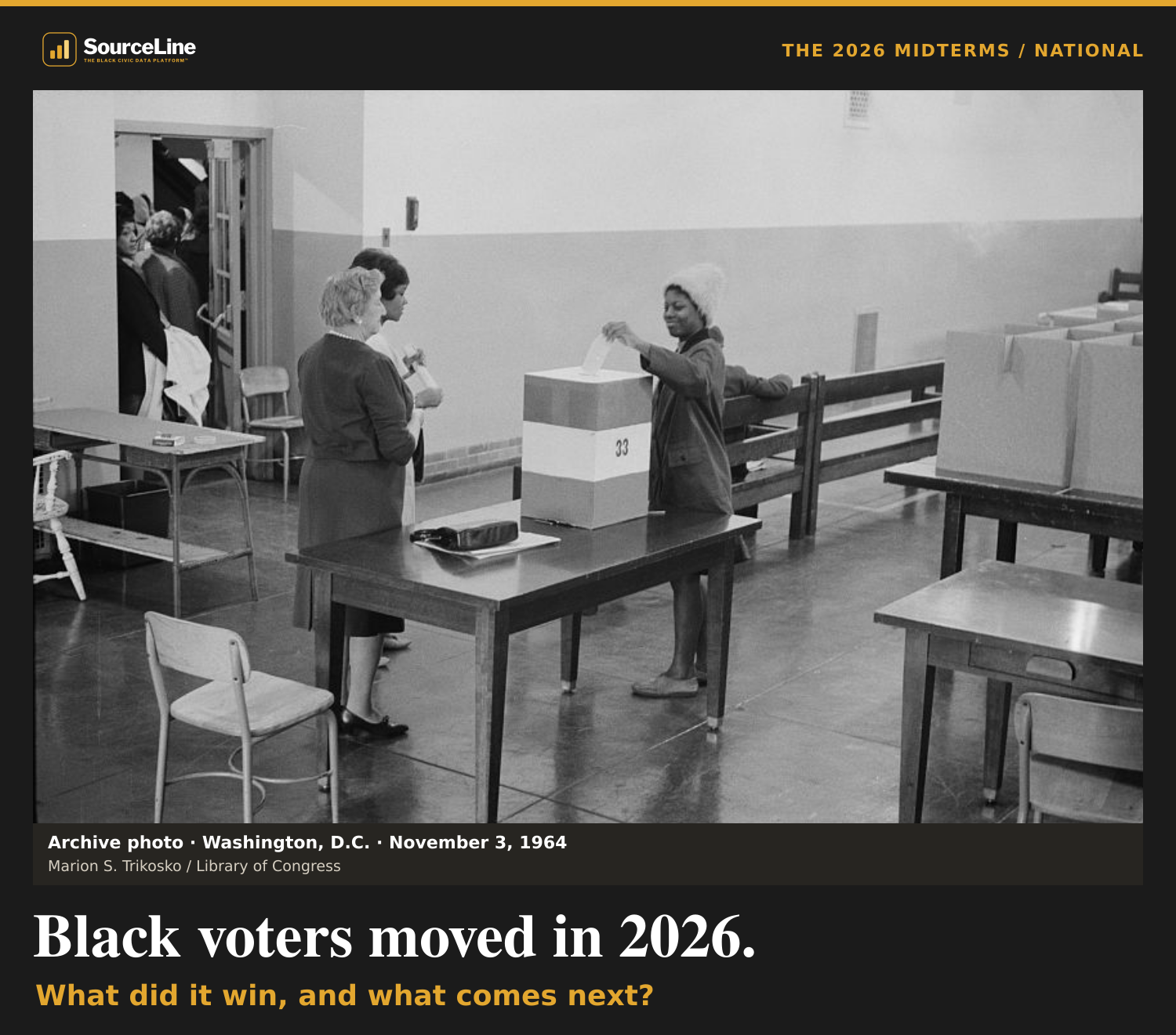
- Photo: Marion S. Trikosko / U.S. News & World Report Magazine Photograph Collection, Library of Congress (no known restrictions on publication)
Checked November 6, 2026. Found an error? Write to info@mysourceline.com.